



Cold Email in 2026: What Changed and What Still Works
Cold email is not dead.
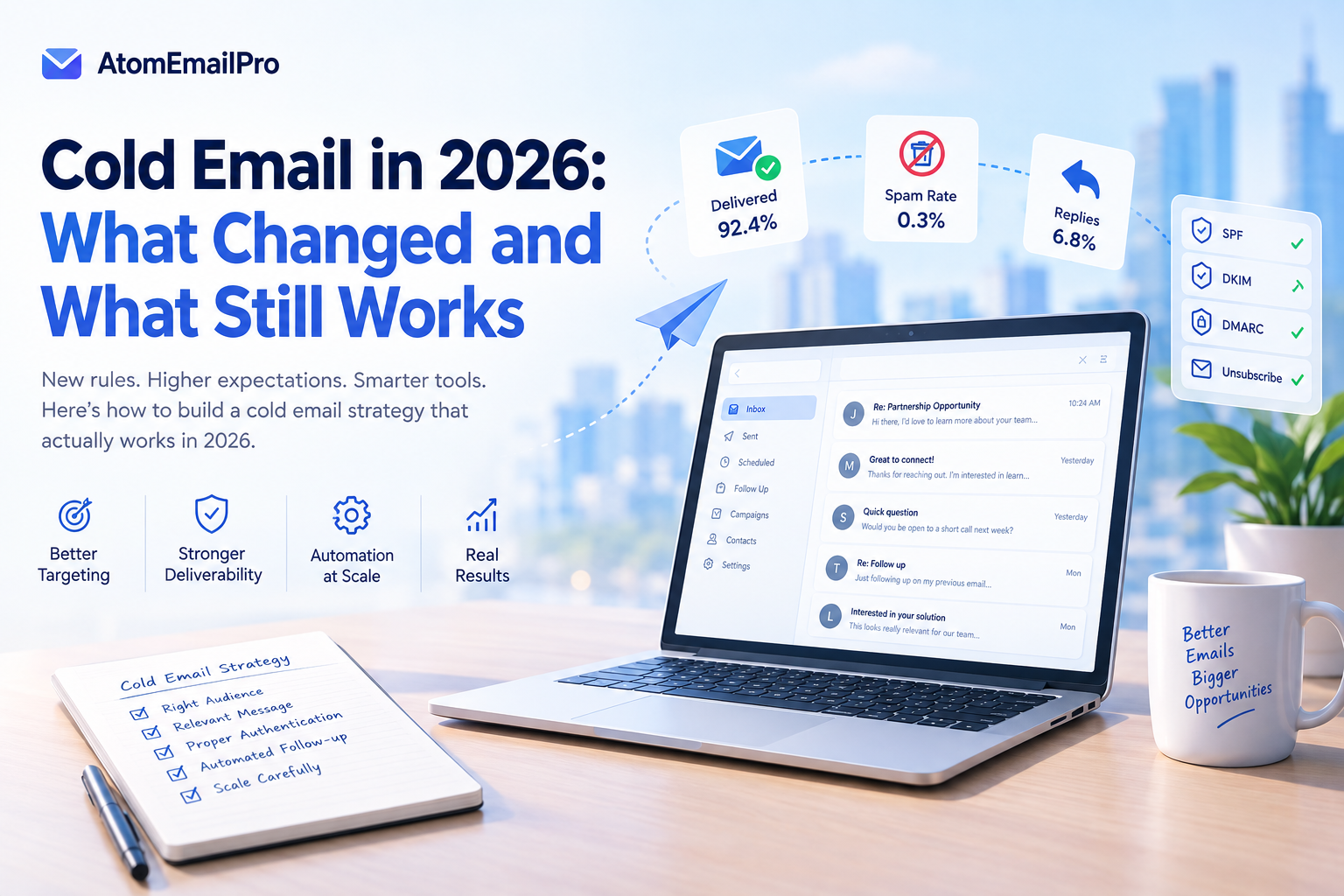
But cold email in 2026 is very different from cold email a few years ago.
Sending thousands of identical emails from one mailbox and hoping for replies is no longer a serious outreach strategy. Modern inbox providers pay much more attention to authentication, spam complaints, sending behavior, domain reputation, unsubscribe mechanisms, and the overall quality of the messages being sent.
At the same time, automation has become easier than ever.
You can now use AI to write personalized messages, software to manage campaigns, and automation tools to handle thousands of emails without manually clicking “Send” all day.
So what actually works in 2026?
The answer is not simply “send more emails.”
The better strategy is:
Build a better system, then scale it carefully.
This guide explains what has changed in cold email, what still works, and how businesses can approach cold email automation at scale without treating volume as the entire strategy.
Cold Email Has Changed
The biggest change is simple:
Email platforms have become much better at identifying unwanted email.
Google's current sender guidelines require authentication and other technical and sending-practice requirements for mail sent to personal Gmail accounts. For senders reaching around 5,000 or more Gmail recipients in a 24-hour period, Gmail requires SPF, DKIM, DMARC, valid DNS configuration, TLS, alignment between the sender domain and authentication, and one-click unsubscribe for relevant marketing messages.
Yahoo has similar expectations for bulk senders, including SPF and DKIM, DMARC, easy unsubscribe, valid DNS records, and low spam complaint rates.
This means the old idea of:
Get a list → write one email → send 100,000 copies
is increasingly unreliable.
Modern cold email is much closer to an infrastructure problem.
You need to think about:
- Who you're contacting
- Why you're contacting them
- Whether the data is accurate
- How your domain is authenticated
- How quickly you're sending
- How recipients respond
- How many people complain
- How easily people can unsubscribe
- How you manage follow-ups
- How you scale the campaign
The software can automate the process.
It cannot make a bad campaign good.
What Still Works in Cold Email in 2026?
Despite all the changes, the fundamentals of cold email haven't disappeared.
In fact, the fundamentals may be more important than ever.
1. Relevant Targeting Still Wins
The first question shouldn't be:
How many emails can I send?
It should be:
Who actually needs this?
Imagine two campaigns.
Campaign A
You send 50,000 emails to random business owners.
The message says:
“We offer an amazing solution that can help your business grow.”
Campaign B
You send 5,000 emails to companies that clearly match your ideal customer profile.
The message addresses a specific problem those companies are likely experiencing.
Campaign B has a much better starting point.
Why?
Because relevance matters.
The best cold email doesn't feel like a random advertisement. It feels like a message that has a reason to exist.
2. Personalization Still Matters — But It Has Changed
Personalization used to mean:
Hi {{FirstName}},
Today, simply inserting someone's first name is barely personalization.
Modern personalization can include:
- Company information
- Industry
- Job role
- Product category
- Recent business activity
- Specific pain points
- Geographic market
- Existing technology
- Relevant business context
For example:
Generic
Hi John,
We provide powerful marketing software for businesses.
More relevant
Hi John,
I noticed your team is expanding its outbound sales operation across several markets. Managing prospecting across those markets manually can quickly become time-consuming.
The second message gives the recipient a reason to keep reading.
AI can make this process much faster.
But there's an important distinction:
AI-generated personalization is not automatically good personalization.
If AI simply produces 100,000 slightly different versions of the same generic pitch, you're still sending generic outreach at scale.
3. Short Emails Still Work
Cold email doesn't need to look like a newsletter.
In many cases, shorter is better.
A simple structure works well:
Context
Why are you contacting this person?
↓
Problem
What problem might they have?
↓
Value
What can you help them accomplish?
↓
CTA
What should they do next?
For example:
Hi Sarah,
I noticed your team is hiring several SDRs this quarter.
When outbound volume increases, managing prospect lists and follow-ups manually can become difficult.
We built a tool that helps teams automate large-scale email campaigns while keeping campaign management in one place.
Would it be useful if I sent you a quick overview?
That's enough.
You don't need five paragraphs explaining every feature.
4. Follow-Ups Are Still Important
One email rarely tells the whole story.
People are busy.
An email may be relevant but simply arrive at the wrong time.
That's why a good cold email strategy usually includes a follow-up sequence.
For example:
Day 1: Initial email
Day 3: Short follow-up
Day 7: Additional context or value
Day 12: Final follow-up
The exact timing depends on the audience and campaign.
The important point is that automation should manage the process consistently.
Instead of manually remembering:
“I need to follow up with these 327 prospects tomorrow.”
your email automation software can handle scheduling and campaign execution.
5. Email Deliverability Is Now Part of Your Strategy
This is probably the biggest difference between modern cold email and old-school bulk email.
You can't separate sending from deliverability anymore.
Your campaign may have an excellent subject line and a great offer.
But if your emails don't reach the inbox, none of that matters.
Google recommends that senders authenticate their domains and monitor spam rates. For bulk senders, SPF, DKIM, and DMARC are required, while marketing and subscribed messages need to support one-click unsubscribe.
Google also provides Postmaster Tools so senders can monitor delivery-related data and compliance information.
Yahoo has similarly emphasized authentication, low complaint rates, and easy unsubscribe for bulk senders.
This creates an important principle:
Sending more email doesn't automatically create more results.
Poor sending practices can create the opposite effect.
What About Sending 10,000 or 100,000 Emails?
This is where many people misunderstand email automation.
They think scaling means:
1,000 emails
↓
10,000 emails
↓
100,000 emails
That's only the volume side of the equation.
Real scaling looks more like:
Better targeting
Better infrastructure
Better campaign management
Better monitoring
Controlled sending
Relevant content
=
Scalable outreach
If you simply multiply a bad campaign by 100, you don't get a better campaign.
You get a bigger bad campaign.
Cold Email Automation Is About More Than Sending
This is where specialized software becomes useful.
Imagine managing a large campaign manually.
You need to:
- Import prospects
- Create campaigns
- Write messages
- Insert variables
- Manage multiple campaigns
- Schedule emails
- Manage follow-ups
- Track sending activity
- Handle errors
- Review campaign performance
- Stop or modify campaigns when necessary
Doing this for a few dozen prospects is manageable.
Doing it for thousands or tens of thousands becomes a completely different problem.
That's where cold email automation software can save significant time.
A tool such as AtomEmailPro can handle the repetitive execution layer of email campaigns, allowing users to organize campaigns and automate large-scale sending instead of manually processing every message.
The goal isn't simply to press a button faster.
The goal is to make a repeatable email workflow possible.
AI + Cold Email: The Biggest New Opportunity
AI has changed email outreach dramatically.
It can help generate:
- Subject lines
- Email variations
- Follow-ups
- Personalized introductions
- Different value propositions
- Industry-specific messaging
- A/B test variations
But there's a trap.
AI makes it extremely cheap to create email.
That doesn't mean you should send every email AI generates.
In fact, the lower the cost of generating messages becomes, the more important human judgment becomes.
Think about it this way:
AI can make bad outreach scalable too.
If you give AI a bad prospect list and ask it to generate 100,000 personalized emails, you'll end up with 100,000 personalized emails going to the wrong people.
Automation doesn't fix strategy.
It amplifies strategy.
The New Cold Email Funnel
A modern cold email campaign can be thought of as a system:
Step 1: Define the audience
Who is your ideal customer?
Step 2: Build a quality prospect list
Find relevant contacts and remove invalid or inappropriate addresses.
Step 3: Prepare your sending infrastructure
Configure the necessary authentication and technical settings.
Step 4: Create relevant messaging
Write messages based on the recipient's situation.
Step 5: Start with controlled sending
Don't treat maximum volume as the starting point.
Step 6: Monitor results
Watch replies, bounces, complaints, delivery problems, and other campaign signals.
Step 7: Optimize
Improve targeting, messaging, timing, and campaign structure.
Step 8: Scale
Once the system works, increase volume carefully.
This is much more sustainable than simply asking:
“How do I send 100,000 emails?”
Cold Email vs Bulk Email
These two terms are often used interchangeably, but they aren't exactly the same.
Bulk Email
The primary idea is volume.
For example:
Send one campaign to 50,000 subscribers.
This is common for newsletters, announcements, promotions, and other large mailing campaigns.
Cold Email
The primary idea is outreach to people who don't already have an established relationship with the sender.
The strategy therefore depends heavily on:
- Targeting
- Relevance
- Personalization
- Timing
- Value
- Compliance
- Reputation
This distinction matters because high volume does not automatically equal effective cold outreach.
What Doesn't Work as Well Anymore?
Several old-school approaches are becoming increasingly risky or ineffective.
1. One Domain + Massive Volume
Sending huge volumes from a single domain without considering reputation is not a sustainable scaling strategy.
2. Generic Messages
If thousands of recipients receive essentially the same irrelevant pitch, engagement is likely to suffer.
3. Ignoring Authentication
SPF, DKIM, and DMARC aren't optional technical decorations.
They're part of modern email infrastructure.
4. Ignoring Unsubscribes
If someone doesn't want your messages, continuing to send them is a poor strategy.
Modern sender requirements increasingly emphasize easy unsubscribe mechanisms.
5. Measuring Success by Sent Emails
“100,000 emails sent” is not a business result.
Better questions include:
- How many reached the intended audience?
- How many were relevant?
- How many generated replies?
- How many qualified conversations?
- How many became customers?
So, Is Cold Email Still Worth It in 2026?
Yes.
But the game has changed.
Cold email is no longer primarily about finding the biggest sending button.
It's about building a reliable system around:
Targeting
Messaging
Authentication
Deliverability
Automation
Follow-up
Measurement
Optimization
The companies that understand this will have a significant advantage over companies that simply try to increase sending volume.
Where Does AtomEmailPro Fit?
This is exactly where email automation software becomes useful.
AtomEmailPro is not a replacement for a good offer, a relevant prospect list, or responsible email practices.
Instead, it can help automate the repetitive operational side of large-scale email campaigns.
Instead of manually handling every campaign and every sending task, users can build a more structured workflow around email automation.
The important distinction is:
Automation should make a good email strategy scalable — not make a bad strategy bigger.
That's the mindset businesses should take into 2026.
Final Thoughts
Cold email isn't disappearing.
Low-quality cold email is.
As inbox providers become more sophisticated, successful outreach requires more than simply increasing volume.
You need the right audience.
You need a relevant message.
You need properly configured email infrastructure.
You need to respect recipient preferences.
And when your strategy starts working, you need automation to make the process manageable at scale.
That's the real opportunity in 2026.
The future of cold email isn't:
Send more.
It's:
Target better. Automate smarter. Scale carefully.